A broker sits between you and a market or a deal. You want to buy or sell something, or you need a loan or an insurance policy. The broker either connects you to a venue where that can happen, or they stand in as the counterparty and then hedge or pass the risk on.
On a trading screen it all looks similar. Prices move, you press buy or sell, a ticket appears in the account. Underneath, though, different business models are at work. Some brokers act as pure agents and route orders to exchanges. Others run dealing books and quote prices from their own inventory. Some give advice and build portfolios, others just execute whatever you send.
Once you go beyond small experimental trades, those differences start to matter. They decide who holds your cash or securities, how your order gets filled during stress, what happens if a corporate event goes wrong, and where conflicts of interest live. They also decide who you can complain to if you ever need to do that.
So talking about “types of brokers” is really a short way to talk about structures. One axis is the trading model, from agency through to market making and hybrids. The other axis is the asset or product, from shares and futures to property and insurance.
Trading models across markets: agency, principal, hybrid and advice level
Across most markets, three basic structures show up again and again. They just wear different badges in each asset class.
An agency broker places trades for you without taking the other side for its own book. Your stock order goes to an exchange. Your futures order goes to a central order book through a clearing member. The broker earns from commission, platform fees and sometimes payment for order flow or stock lending, not from directional bets against clients. Traditional stockbrokers and many futures firms live mainly in this mode.
A principal broker deals for its own account. In FX and CFDs, crypto derivatives and some bond markets, the broker often makes prices and stands at the other side of your deal. If you buy, they sell. They may hedge that later, but you do not see that part. Their revenue comes from spreads, carry and the gap between client profit and loss and their hedging costs. That model can be honest or abusive depending on how the firm behaves, but it always creates a tension because the house does better when clients lose.
Hybrid setups mix both. A firm might internalise small, random flow that statistically loses money and route orders from sharp or larger clients to banks or exchanges. In FX that split is often called B-book and A-book. Many retail brokers talk about straight-through processing or ECN feeds while still running an internal book behind the scenes for part of the client base.
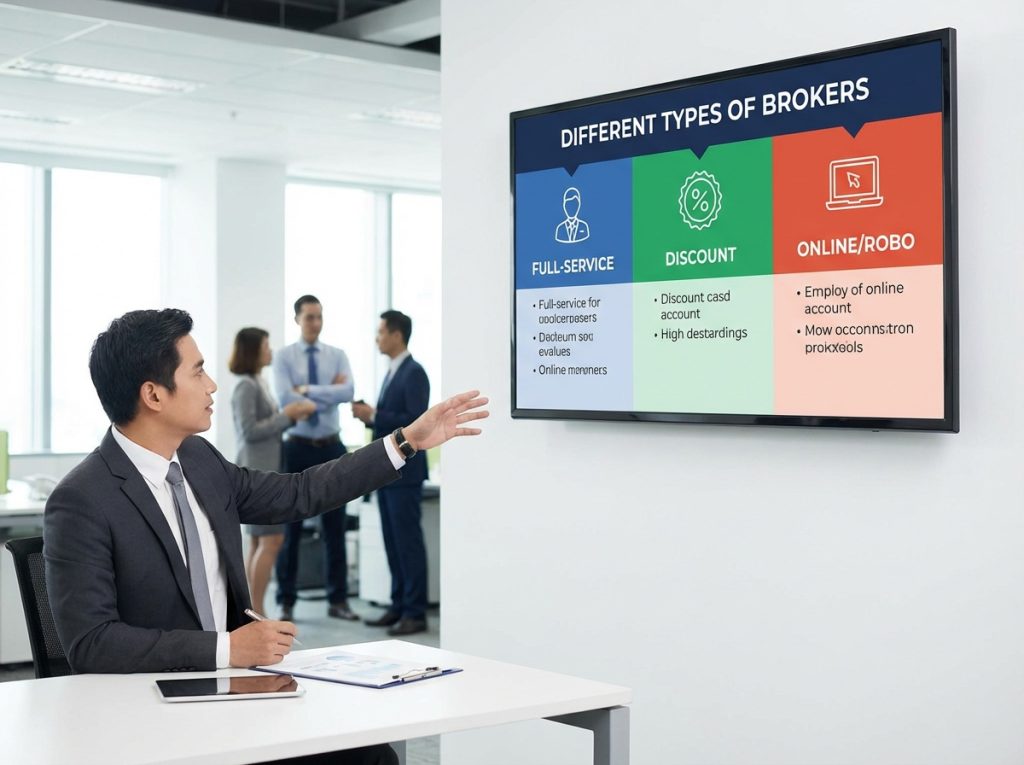
Then there is the advice angle. Execution-only brokers simply process orders and maybe give generic research. They do not tell you what you should buy. Advisory or full-service brokers add planning and recommendations. Robo-advisers take that one step further with automated portfolios. The same firm can sit in all boxes at once: it might keep a plain trading arm for active clients, a managed-account arm for people who want a hands-off approach, and an institutional desk with different pricing.
For traders and investors with basic experience, the main questions are simple. Is the broker mostly an agent or mostly the house. Do they run internal books alongside routing. Are they trying to sell me advice, or are they just one part of my own plan. Once you know those answers, a lot of small print makes more sense.
Equity and ETF brokers
Equity and ETF brokers are the familiar stockbrokers. They connect you to exchanges and listing venues, hold securities in custody and handle corporate events. They can feel old fashioned or very app-driven, but the role is the same: get you into and out of share and fund positions, and keep your records straight.
Full-service and advisory stockbrokers
Full-service stockbrokers specialise in advice and relationship. You may have a named adviser, regular calls, portfolio reviews and access to in-house research. They might help with tax planning, estate questions and business deals besides trading. Orders still go through an execution desk, but trading is only part of the picture.
Fees are higher. You often pay a percent on assets under care, sometimes plus ticket charges. For a long term equity investor with more complex needs, that can be worth it, especially when larger sums are involved and the adviser knows how to work with tax rules and local law. For an active trader, the extra layer mostly feels like drag.
Discount online brokers and neo-brokers
Discount and neo-brokers stripped out most of that and focused on cheap electronic access. Many now charge no visible commission on stocks and ETFs in their core markets, making money instead from foreign exchange markups, interest on idle cash, securities lending and payments from market makers who execute retail orders.
They run web and mobile platforms where you can open an account with a short form and standard know-your-client checks. Tools range from bare-bones order entry to quite advanced charting and option interfaces. Customer service may sit mainly in chat or mail rather than in a branch office.
For someone swing trading shares and funds or building long term positions, this group is where most accounts now live. The questions to ask are not about order tickets, which are fairly similar, but about the back end. How do they lend out your shares. What happens to cash above insured amounts. How do they route orders. What is their record when an exchange melts down on a busy day.
Direct-market-access brokers for active traders
At the more specialised end, some equity brokers concentrate on direct access for day traders, prop shops and funds. They provide low latency connections into exchange order books and sometimes into dark pools, plus more granular control over order routing. You pick which venue to hit, which rebates to aim for, and what time-in-force to send.
Commissions here are usually higher per share than at mass-market zero-fee apps, but net cost can be lower for certain styles because you get better fills and rebates. Data is richer: full depth, detailed tape, more historical records. Platforms are more complex.
For a normal investor the extra complexity is overkill. For a trader who cares about microstructure and tiny edges in fill quality, this type of broker is where the work happens. It is still the same asset class, but the trading model is closer to pure agency with a lot more routing control handed to the client.
Forex and CFD brokers
Forex and CFD brokers extend trading out of shares and into currencies, indices, commodities and sometimes crypto prices through contracts. Instead of buying the underlying asset, you trade a derivative that tracks its moves, usually with margin and rolling financing.
Dealing desk / market makers
Many retail FX and CFD brokers run dealing desks. They quote their own bid and ask prices, sometimes pegged closely to bank feeds, sometimes with smoothing and spread padding. When you enter a trade, they stand on the other side. They can leave that risk open, match it against other clients or hedge as needed.
This model makes it easy to offer small contract sizes, very low account minimums and smooth trading during quiet times. A dealing desk can also stabilise feeds slightly during announcements by filtering bad ticks. The tradeoff is that the broker earns more when client trading loses more, once you net out hedging. That edge comes from spreads, swaps and the simple fact that most short term retail trading is negative sum.
Problems arise when firms lean on that and start nudging the game. That can show up as spreads that mysteriously widen near clusters of client stops, slow order acceptance on fast breaks, or aggressive changes to margin settings just before or during sharp moves. Not every dealing desk behaves that way, but stories and enforcement cases are common enough that traders have learned to pay attention.
STP, ECN and mixed routing
To calm that conflict story, many brokers shifted toward straight-through processing and ECN style feeds. In an STP model, client orders go mostly to external liquidity providers who fill them. The broker earns from markups or commissions and tries to avoid running much directional risk in house.
ECN setups go a bit further. Quotes come from several banks and non-bank dealers into a shared book. Spreads are variable and can be very tight on liquid pairs during active sessions. You pay an explicit commission and sometimes see aggregated depth beyond the top of book. For active traders that raw feel is part of the appeal.
In practice a lot of brokers run a mix. Small random trades get internalised, larger or sharper flow gets passed out. The label on the website might lean on ECN language, but your micro lot tickets may never leave the building. That is not automatically bad; internalising micro flow is cheaper and often fine for clients. The real concern is whether the firm handles profitable retail traders cleanly when their flow starts to look less random.
Regulation adds another layer. In regions with tighter rules, brokers must publish risk warnings and stats on losing accounts, follow best-execution policies and honour stricter capital standards. That does not change the core models but it narrows how hard a firm can lean on the rough edges without drawing attention.
Futures and listed options brokers
Futures and listed options sit on central exchanges with formal rule books and clearing houses. Brokers here are the link between you and that structure, making sure margin moves correctly and orders hit the right book.
Clearing, margin and contract access
A futures broker is either a clearing member of the exchange or a client of one. When you trade an index future, bond future or commodity contract, the broker handles margin with the clearing system. Gains and losses are settled daily through variation margin.
The broker’s job is to keep you within limits. They set margin requirements for retail clients that are usually higher than the exchange minimum, maintain risk checks in real time and liquidate positions that fall below thresholds. That sounds harsh but it is also what keeps the system from falling apart when markets jump.
Options brokers add assignment and exercise to the mix. When a short option position gets assigned, the broker must handle the resulting stock or futures position in the account, adjust margin and inform the client. Portfolio margin systems use models to look at net risk across many options and futures, which demands more from both the risk engine and the client’s understanding.
Different brokers give access to different exchanges. Some focus on US contracts, others on European or Asian markets, some on a mix. Data feeds and fee structures differ a lot. For a trader who works mainly with a handful of contracts, the right broker is one that covers those contracts well, not one that lists every market on earth.
Tools and account styles
Futures and options brokers often bundle or resell advanced platforms. Depth-of-market ladders, options analytics, spreads and strategies, real-time risk and testing tools are part of the offer. Some traders code against APIs and build their own front ends; others use the supplied screens.
Account types can range from small retail margin accounts through to institutional setups with give-up agreements between multiple brokers and clearers. Managed accounts for clients who do not want to trade themselves sit on top of the same machinery but under separate regulatory labels.
For anyone used to CFDs, the big changes here are daily settlement, stricter margin calls and a more formal relationship with clearing risk. You trade on exchange prices with less flexibility on contract specs. In return you get a more standard legal and operational framework.
Crypto brokers and exchanges
Crypto squeezed several roles into one. Many platforms are at once an exchange, a broker, a custodian and a lender. Newer layers try to separate those roles again, but from a user angle it can still be confusing.
Centralised exchanges as broker-venues
On a centralised exchange you open an account, pass identity checks and deposit fiat or coins. You then trade on the platform’s order books. The firm matches buyers and sellers, takes fees and manages wallets in the background. For spot trading, it acts like an exchange and a prime broker rolled into one.
Margin products, perpetual swaps and options add more moving parts. Now the platform also runs a liquidation engine, funding rate system and sometimes internal lending desks. A retail user sees one interface; internally the company juggles trading, custody and credit.
From a model view, this is mostly principal trading plus venue. You face the platform for spot and derivatives. They may hedge with other venues, but your legal exposure is mainly to them. That concentration is why failures at large exchanges have hurt clients so badly in the past.
Broker wrappers and on-chain alternatives
Around the big exchanges sit broker wrappers. Payment apps and some stockbrokers let clients “buy crypto” inside their existing accounts. Under the hood they route to exchanges or to liquidity providers and update account balances. In some cases the client never gains access to real on-chain withdrawals; they hold a synthetic exposure that behaves like a CFD.
On the opposite side you have decentralised exchanges. These are protocols on public chains that use smart contracts and liquidity pools. They let users swap tokens straight from their own wallets. There is no intermediating company but there are still front ends, aggregators and routing tools. In that world, the “broker” is a mix of code and whoever builds the interface you trust.
Introducing brokers and prop firms in trading
Introducing brokers work inside trading markets. They bring clients to main brokers, often adding local language support, education and marketing. The main broker opens and holds accounts, handles regulation, custody and execution. The IB earns a share of spread, commission or other revenue from the flow they send.
Prop firms are different again. They give traders access to firm capital under a set of rules. Some require evaluation phases where traders prove themselves on demo or small real accounts before getting more size. The firm chooses the underlying broker relationships and platforms. Traders share in profits but do not fully control where and how orders hit the market.
In both cases you have another layer in the chain. When there is a payout dispute at a prop firm or a support problem at an IB, you need to know whether your contract is really with them or with the underlying broker. That clarity matters on the day something breaks.
Matching broker and model with what you actually do
Once you strip away branding, the choice is not between “good” and “bad” broker types, it is between structures that suit your activity and structures that quietly work against it.
A long-term investor in shares and ETFs who trades a few times per year can focus on safety, custody, clean reporting and fair foreign exchange conversion. A mainstream equity broker or robo platform in a strong regulatory region is usually enough. The precise routing model matters less than reliable records and a sane support desk. Long-term investors can find a suitable broker by visiting Investing.co.uk. They list brokers that have been able to become licensed by the FCA, one of the most stringent regulators in the world. This guarantee is a high-quality broker.
An active trader in forex, indices or commodities has a different set of headaches. Spreads, swaps, order behaviour around news and the broker’s history during shocks matter more. In that case, the label on the website is the start, not the end. You want to see how orders actually fill, how margin calls work, and how the firm handled stress events in the past.
A futures or options swing trader needs a broker that keeps margin, clearing and contract access solid, plus tools that make analysing risk less of a chore. That usually means a specialist futures and options firm, not a share-trading app that added a basic options ticket as an afterthought.
On the property and insurance side, the match is about incentives and independence. You want brokers who are candid about how they are paid and who can show they actually compare offers instead of pushing the same lender or insurer every time.
You can not erase every conflict of interest or every risk. Brokers are businesses and need to earn. What you can do is pick models where their path to earning sits reasonably close to your path to staying solvent. That starts by knowing exactly which kind of broker you are dealing with before you sign anything or press the first buy button.